Showing posts with label VVF. Show all posts

Friday, March 18, 2011

Fistula in Ethiopia

This video pretty clearly explains about VVF, the "Hospital by the River" in Adis Ababa, Ethiopia that is dedicated to providing free surgeries for these women, and shows a bit of what I want to do after grad school.

Check out 4:05 for pictures of the physical therapy available for VVF patients, and 5:14 for a glimpse of "Dester Menda", the village I would like to build one similar to.

Monday, January 10, 2011

Dreams...

God, You blow me away.


Per Dad's request, my family's been reading "Put Your Dream to the Test" by John Maxwell. He and Mom have been leading a small group through the book and it's been interesting to hear what the group's been learning.

Go buy this book. Like seriously.

For those of you familiar with the Life Purpose Planning booklet, John Maxwell's book takes it a step farther. LPP focuses on finding the "golden thread" of God's hand in your life as you write down people that have influenced you, verses that have stood out to you, books you've read, experiences you've enjoyed, the meaning of your names, your spiritual gifting... it's actually a rather exciting little booklet and it was a good tool to kind of figure out that God's been preparing me for a life of investing into younger girls and has called me to something in the medical field and that all the traveling I've done is in preparation for overseas missions.

But "Put Your Dream to the Test" comes at it from a little more of a secular side. Mr. Maxwell says, "go dream... what's the biggest thing you can imagine... now, let's make sure it's something that is actually feasible and what needs to happen to get you there?"

I'm only on the 3rd chapter, but I wanted to share what I've come up with for the answers to the 1st chapter's questions. Maxwell encourages the reader to write down their dream and share it with others. If I can succinctly communicate my dream to those I care about and show my passion in a coherent manner that's a big first step--and a necessary skill for raising the money, personnel, and resources I'll need to carry out my dream.

The following dream has been inspired by many things; but especially by a paper I had to write last year for school, the book "The Hospital By the River," and some subsequent research I've done about that hospital.

I realize that this is not the normal type of post you'd expect out on a blog for the world to see (not that this blog is followed/RSS subscribed to by more than a few dozen people), but I want your comments.

Is this something you could see me doing? Will ya'll remind me of this when I post how much I hate PT school and anatomy lab?

And expect to see more installments as I delve into more of "Put Your Dream to the Test."


My Dream (December 31, 2010)

I desire to be a wife and mom, first and foremost.

I will, Lord willing, spend my life in sub-Saharan Africa, using physical therapy full time until I have a family (after which PT will become a part time position). I foresee myself working at a missions hospital compound, not in a small remote village.

I want to use PT with the amputee and VVF outcasts of Africa as a follow-up to surgeries performed.

After I have spent several years in Africa, have made connections, gained their trust, and built my “dream team,” I want to build a village for my patients where they can live for as long as they need PT or if they cannot return home. New patients will come to the center of the “village” to the “PT hut” for therapy, longer term patients will assist new patients, and permanent residents will help teach patients to read/sew/make crafts to bring in money.

My ideas for this village are based off a project already in existence with the International Fistula Foundation’s branch in Ethiopia, which can be found here: http://www.fistulafoundation.org/wherewehelp/ethiopia/longtermcare.html

Questions from John Maxwell’s “Put Your Dream to the Test” book:
Chapter 1

1.    The Ownership Question: Is my dream really my dream?
A.   What would I do if I had no limitations?
·         Go train with the PTs at “The Hospital by the River” in Ethiopia
·         See answers to C
B.   What would I do if I had only five years to live?
·         Graduate from A&M
·         Go to Nigeria this summer and learn alongside the nationals how to make prosthetics, and then be a lay PT there in Africa.
·         Get married
C.   What would I do if I had unlimited resources?
·         Donate money to NGOs like Mercy Ships and International Fistula Foundation to provide VVF surgeries and housing/training for chronically incontinent women
·         Build a “village” for VVF women and amputees where they share a little “hut” and there’s a PT clinic in the middle to provide long-term care.
·         Create a “dream team” of international healthcare professionals to fully staff the “village” and set it up as a clinical/training site for both international and local healthcare professionals to come train.
D.   What would I do if I knew I couldn’t fail?
·         Complete PT school
·         Get specialized in women’s health PT and prosthetic gait training
·         See answers to C

Thursday, April 15, 2010

What's on my bookshelf right now...

I have this ever-increasing stack of books on the shelf by my bed in my dorm room... this stack has recently undergone a growth spurt thanks to my recent discovery of $65 sitting in my Amazon.com account, and has been added to through borrowings from college friends.

Then there's the non-existent stack of books I have finished reading. It's non-existent because I've passed them on, loaned them out, or sent them home for my parents to read... good books are like a good pot of coffee--they're so much better when they're savored slowly and shared with a friend!

So here are a few of my wordy friends, perhaps you'll find something to read just in time for summer! I'm not going to do a book review by any means, but I just want to share a few thoughts with ya'll. (Click the image to go straight to Amazon.com for more information)\

Brown Like Coffee - The List Guy
I received this book as a thank-you gift from the A&M Navigators staff this past Christmas and it sat on my shelf for quite a few weeks! It's thin size didn't seem too daunting and I actually enjoyed it's warm and upbeat message that is directed to churched college students. Each section of the book starts out with a description of a specific coffee drink and then makes an analogy to the Christian life. I found it to be quickie read, and the thought provoking questions and easily applicable challenges helped get the concepts out of the page and into real life. It's a good book to read once and pass on to a college-aged friend.


Through the Dark Woods - Joann Swinney
I wish I found this book earlier. It's written from the heart of an English girl in her early 20s. She writes from the Christian perspective and incorporates a good bit of scientific data about depression and addresses the social stigmas associated with it. It's a wonderful book for those who know someone who is depressed, are worried about a loved one and aren't sure how to broach the topic, or for the depressed person themselves. One chapter provides a long list of things a person suffering from depression can do to stop the cycle ... journaling, making a pot of good tea, trying a new recipe, going window shopping, going on a brisk morning walk... This is the first book I have read that has acknowledged both physical, mental, and spiritual aspects of depression or that has indicated that returning from depression is not an easy affair that happens overnight.

For Young Women Only- Shaunti Feldhan
I've heard about this book for several years and finally bought it! I love the subtitle: "What you need to know about how guys think." Yeah, there's a lot that us girls WANT to know about guys (and we have magazines like Teen Vogue and Cosmopolitan to satisfy that), but what do we NEED to know in order to live our lives more appropriately and help our Christian brothers out? The statistics from thousands of young men from all different walks of life were really helpful and showed me a different side of the male population! The best thing about this book was that the authors give you the facts, share the Spiritual truth that correlates, but allows the reader to decide what she will do about it. It's not a book of rules by any means, but a good resource to have. Several girls have asked me about modesty, appropriate levels of sarcasm with guy friends, and have sought me out for relationship advice and it's been neat to show them what guys across the country have to say on those topics! It's also helped dispel some of the myths I've had about brothers and guys in general, even after I've grown up around so many guys!

Lies Young Women Believe - Nancy Leigh DeMoss
I haven't started this book yet, but I look forward to more of Nancy Leigh DeMoss' heart-to-heart truth! It looks like a great book for high school girls working through it on their own or perhaps with a small group of friends. It's different from "Lies Women Believe" in that it includes sections of questions and room to journal. The 25 lies tackled in this book include "beautiful girls are worth more," it's OK to one person at home and another with other people... especially online," and "I can't handle the loneliness of staying pure."


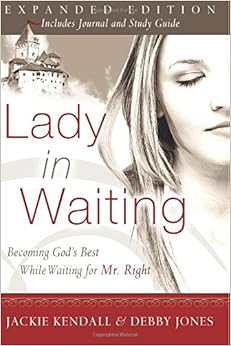
Lady in Waiting - Jackie Kendall & Debby Jones
I have not read this one either, but the subtitle also intrigued me; "Becoming God's best while waiting for Mr. Right." It's a pretty thick book but includes an in-depth workbook at the back. I think this will be a good part of my summer devotions.  :-)


The Hospital by the River - Catherine Hamlin
This is an autobiography of a woman who with her husband started the first fistula repair hospital in Africa back in the 1950s. Since then the facility has helped over 20,000 young women return to society after a procedure to correct damage done by an obstructed and prolonged childbirth process. Mercy Ships does a number of these corrective surgeries and one of the current ship crew recommended this book to me--aparently, many of these women also participate in physical therapy as part of their post-op care! I'm super excited to dig into this book and learn a little more about the incredible medical needs in Africa and I'm inspired by this woman's passion for the physical and spiritual restoration of each patient!

Saturday, April 10, 2010

What I want to do with the rest of my life...


This semester in my Majors-only Writing Intensive Yoga class (yes, I know that it sounds really weird!) we're learning to write funding proposals. The semester's assignment was to write a proposal for a program that we wanted to implement after we finished college/grad school. 

Others chose to write about afterschool sports programs, mobile therapy clinics, or playgrounds for pediatric hospitals, and I chose to write about something that I really am passionate about. I hope that as you read this, you'll catch a glimpse of what I want to do with my life and where I feel God leading me!


Hope for Nigerian Amputees: Manually-Powered Prosthetic Fitment
Katherine E. Farr – Final Paper - Wednesday, April 7

Introduction
The African civil wars and conflicts of recent decades have left thousands of people injured; rural land mines that continue to explode injure people and often leave them with lower limb amputations (Arya and Klenerman, 2008). Although a prosthetic was created in 1975 to suit the unique lifestyles of third-world patients, and several organizations now provide them at no cost (Tuli, 1981), many of these amputees will never receive one because they cannot afford to take the time to travel and be fitted.

Some of these non-governmental organizations also face the problems of overwhelming need, insufficient funds, inadequate facilities, and unreliable electricity. New techniques have been developed to resolve some of the issues, but all of the techniques still rely on electricity. Current donors to the Evangel Missions Hospital in Jos, Nigeria, will receive a copy of this proposal along with the quarterly newsletter, and they will be asked to consider sending an additional donation or to earmark their next regular donation to a fund to purchase a manually-powered fitment device.

Target Population
There are approximately 7,000 physically handicapped people in Nigeria’s capital city of Jos (Ardill, 2006), and many of them support themselves by begging. Evangel Hospital's prosthetic facility has been able to provide lower limb prosthetics to many amputees who live in Jos, but many patients who live in remote areas of Nigeria cannot afford the time or money to travel to Jos even to receive prosthetics free of charge. There is a great need to increase process efficiency and mobility so as to serve the maximum number of people.

Project Description/Rationale
The current fitment procedure is very inefficient. First, the entire casting, fabricating, and fitting process takes 2-3 days—an amount of time that most low-income families and subsistence farmers cannot spare. Secondly, the process requires a large amount of plaster of Paris (approximately 8 lbs (3 kg) per fitment), which means that all plaster must be transported with the machine for field services in more undeveloped areas of Nigeria (Garcia, 2008).

A vacuum-casting procedure has been newly developed to increase efficiency by reducing the entire fitting and fabrication time to an hour and a half and eliminating the need for plaster. However, the vacuum machine is expensive and relies on electricity to provide the negative sand mold of the patient’s stump. Philip Garcia, an undergraduate student at MIT, worked with a team of 20 interdisciplinary students to explore the idea of a manually-powered vacuum machine to be used with the sand-casting technique (Chandler, 2008). The vacuum-casting procedure coupled with the MIT team’s design would provide an effective solution for Evangel Hospital.

The team’s design utilizes four bicycle pumps and 10 other readily available parts. Some of the parts could be replaced with more native materials to further reduce the cost from USD147 to approximately USD50 per machine. The device is lightweight, requires very little setup, and can easily sit on a tabletop; these features allow for extreme portability. Technicians using the machine would not need intensive training, as many of them would be familiar with hand-crank machines common to local water wells. Since the devices are simple, local tradesmen or mechanics could make any necessary repairs.

Expected Outcome
The entire procedure has several huge possible positive outcomes. First, the vacuum-casting procedure has the potential to increase Evangel’s patient load fivefold (Garcia, 2008). Secondly, eliminating the need for plaster will reduce the cost per prosthetic limb. Thirdly, the manually-powered machine will allow the Evangel workshop to operate at all hours, independent of the hospital’s generator and its erratic running time. Fourthly, since the machines do not require electricity, the workshop technicians would be able to organize mobile prosthetic teams to travel into rural Nigeria and serve those amputees who cannot travel to Jos. As a result, many Nigerians would hear about Evangel Hospital, and word would spread about their free or low-cost medical and treatment programs and facilities. Lastly, donors from around the world will have the unique opportunity to make a difference in the lives of many Nigerians by restoring their dignity and livelihood providing them a lower-limb prosthetics.
  
Conclusion
The number of amputees can seem overwhelming, the recent economic situation that reduced Evangel’s donations can be disheartening, and the challenges of serving in a third-world country can be daunting, but the new fitment technique and device offers incredible prospects. With rural prosthetic fitment and fabrication teams many more amputees can learn to walk again, work again, and be a part of society again. Truly, advancements in medicine, engineering, and science—coupled with faithful financial partners—can offer hope for Nigerian amputees.

Works Cited
Arya, A. P., and Klenerman, L. (2008). The jaipur foot. Journal of Bone & Joint Surgery, British Volume, 90B(11), 1414-1416.
Tuli, J. (1981). The jaipur limb. World Health, 2-5.
Ardill, B. (2006). Prosthetics project. Retrieved 3/30/2010, from http://www.ecwaevangel.org/mambo/content/view/248/70/
Garcia, P. (2008). Optimization of vacuum pump device for use in rapid fitment of prosthetic limbsRetrieved 2/22/2010, from http://dspace.mit.edu/handle/1721.1/45794
Chandler, D. (2008). A leg to stand on. MIT News, March 5, 2008.  Retrieved 2/20/2010, from http://web.mit.edu/newsoffice/2008/itw-jaipur-tt0305.html